RUEL: DANCING BETWEEN TRUTH
NOVEMBER 2025

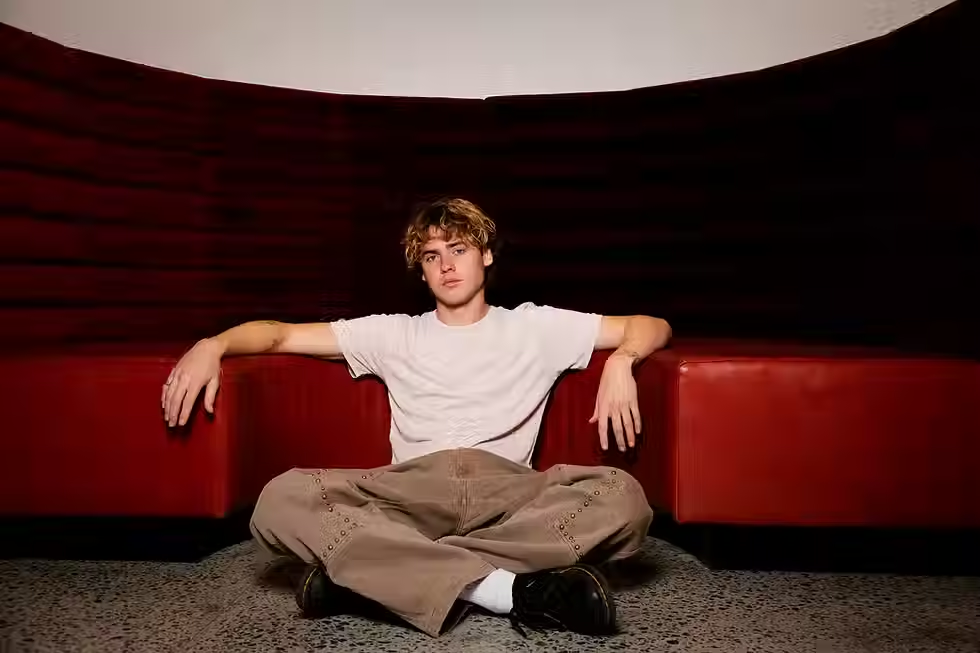
Photographs by Vasili Papathanasopoulos.
Styling by Victoria Knowles.
At just fourteen, Ruel burst onto the music scene with his debut single Golden Years, produced by GRAMMY-winning producer M-Phazes, instantly marking him as a talent to watch. Since then, the Australian pop prodigy has continued to captivate audiences globally through his compelling songs, debut album, 4th Wall, and engaging live show. Last month, he unveiled his sophomore project Kicking My Feet, an album that builds on the foundations of his debut while charting a bolder, more personal path. Confident in his craft and unafraid to experiment, he transforms everyday experiences of love, joy, and vulnerability into a vibrant sonic journey that feels both intimate and expansive. In the lead up to the albums release, I met with Ruel over zoom - in the midst of his global promotional tour. It had been merely hours since his flight had touched down, but the jet lag could not restrain the pride that beamed from him whilst unpacking his sophomore album.
Nearly three years after the release of 4th Wall, Ruel’s sophomore project expands on the foundation he built and ventures further into his artistic and personal world. Making his debut he says offered perspective, and instilled a newfound confidence in his craft. “I had a lot more, I guess, confidence in my own ability, I suppose to get into this one and almost do it faster.” While 4th Wall drew on nearly two decades of life experience, Kicking My Feet was created within a much shorter window. This in turn allowed him to mine previously unexplored aspects of his life. “I kind of went into it wanting to just write different things, use different parts of my life as concepts, or wanted it to feel just different and more mature and just like a progression as who I am,” he recalls. On Kicking My Feet, that progression comes through in songs that trade heartbreak for lightness, finding new ways to document and express the feeling of love.

Ruel wears Fendi. Jewellery, Sunday Stephens.
In the years between albums, Ruel made a decisive shift; permanently relocating to Los Angeles, the city that had long been his creative hub. He estimates that the vast majority of his catalogue was crafted there - “at least 80, 90% of it since I started putting out music.” The move transformed his process from one defined by bursts of productivity during short visits, into something more measured and sustainable. “4th Wall was multiple trips over a couple years,” he explains. Living in the city removed the pressure to make every day count, and in doing so, expanded his approach to collaboration. No longer confined by time limits, he began to follow instinct rather than obligation. “I felt like I could kind of pick and choose my [laughs] writing stints and be a lot more selective about the people I was working with. I definitely also branched out. I was working with people I would never work with if I was just coming here for a trip. I was just trying it out with friends and people I was fans of and just hitting them up and being like, ‘hey, what are you doing tomorrow?’ That’s kind of how a lot of LA writing sessions works. It can be super last minute because everyone’s moving around canceling [laughs].” That flexibility redefined Ruel’s creative rhythm. What once felt like a sprint to capture fleeting moments of inspiration became a steady, evolving practice grounded in community and spontaneity.
Ruel estimates he wrote around two hundred songs for Kicking My Feet. “Too many songs. Way too many,” he confesses, half-laughing at the excess. The sheer volume speaks to both his creative stamina and his restlessness as an artist trying to capture the right tone for his sophomore album. “The way I did it was almost every ten songs that I wrote on average, there was usually one that I would pull out and be like, ‘this is a non-negotiable. Like, this has to go on the album.’ I would pull this out and put it in a note, or put on the whiteboard. That happened about twenty times.” Each of those “non-negotiables” became a small victory; a signal that he was getting closer to the emotional and sonic centre of the record. As he continued to write, the process shifted from pure creation to curation. Rather than facing an unmanageable catalog at the end, Ruel built the album in real time, refining and assembling the pieces as he went. “I didn't just stop at 200 and be like, ‘all right, let's have a look [laughs].’ That would've been insane. I don't think I ever could have put out an album off that, but having an idea as it goes on made it a lot easier.” The final track list (eleven songs distilled from those twenty early must-haves) represents the careful balance between instinct and discipline that defines the project.

Ruel wears Emporio Armani. Jewellery, Sunday Stephens.
Still, Ruel hints that the remaining songs may find a second life someday, clarifying with a chuckle that he means the extra ten, not the entire two hundred. I joke that he could one day release a ten-year anniversary edition featuring every track written for the record. He laughs, drawing a parallel to Mac DeMarco’s One Wayne G. “Mac Demarco put out an album of like 200 songs where they're all just the date he wrote them. You look through the album and it's like, fans have found the hits [laughs]. People have gone through and it's like some songs have got like, you know, a hundred million streams and then some have like 20,000. It's crazy.” In that comparison lies a telling truth: Ruel’s process, while painstaking, carries the same spirit of exploration and openness that defines artists like DeMarco. Whether those cut songs ever surface or not, they form the unseen scaffolding of Kicking My Feet - the hundreds of near-misses that made the eleven that remain shine brighter.
The act of songwriting is a streamlined process for Ruel. He admits that he enters a session “reasonably cold,” a testament to his trust in spontaneity over strict preparation. The process begins simply, often with a chord on guitar or piano, a spark that sets the tone for what follows. “I'd mess around and we'd just jam. I get a few people on some instruments until there's a kind of loop that feels nice. Then we'll put that down and then I'll put some melodies over it, just sketch in some melodies with no lyrics. Then I'd sit, I would take a break and then I'd be like, 'all right, all right, what are we gonna talk about?' I would dump some trauma on whoever is on the room [laughs], or the opposite and just talk about how in love I am. Then we'd write about that. We'd kind of put the lyrics to the melodies. Like that's kind of the most common way for me.” It’s a process that blends improvisation with emotional honesty, a creative alchemy that captures both vulnerability and joy in equal measure. Behind the casual phrasing lies a discipline shaped by years of quiet observation; Ruel keeps a note on his phone filled with titles, concepts, and lines he’s been building for a decade. It’s a living archive of his thoughts, a safety net for inspiration when spontaneity meets structure. In that balance between impulse and intention, Ruel finds not just his sound, but his truth; proof that great songwriting often begins not with certainty, but with the courage to simply start.

Ruel wears: Top, Ruel Merchandise. Trousers, Jean Paul Gautier. Shoes, Jimmy Choo. Jewellery, Sunday Stephens.
Kicking My Feet is a marriage of vulnerability and charm, love and infatuation, growth and maturity. Writing the album became a process of reflection for Ruel, an exercise in confronting his own songwriting habits and the emotional walls he had unknowingly built. “I had always written about breakups and negative things in my life, and I think that was always what I thought was worth writing about. I didn't think it was worth writing about anything remotely positive because I couldn't find a way to make it emotional or make it feel like art or poetic.” That honesty reveals a young artist reckoning with the notion that pain, not joy, is what legitimises emotion in art - a belief perhaps many musicians quietly share. In our conversation, Ruel admits that his personal life tells a different story. “I always kind of struggled with that because I have been in a relationship for the past five years and I want to talk about it, but I always felt like, 'nah, it's cringe [laughs]. I gotta make up another breakup song, whatever.’” His candour captures a generational shift: artists pushing back against cynicism and allowing sincerity to re-enter their work. He credits that breakthrough to time and to his collaborators, who encouraged him to let go of self-consciousness. “Maybe the people I was working with kind of helped me lean into it or maybe just me not giving a fuck as much, the older I get [about] what people think.”
From that mindset came tracks like I Can Die Now, The Suburbs, and the title track. Songs that radiate with the euphoric messiness of love, but never lose the emotional nuance of Ruel’s earlier work. “'Okay, what's the most dramatic and over the top and emotional, but maybe kind of tongue-in-cheek way to say I love you,’” he recalls thinking while penning the album. The same emotional current flows through Only Ever and Not What's Going On, each one threaded with the vulnerability he once reserved for heartbreak alone. “I think for the most part, a lot of the writing was based around me trying to open up a different part of my vulnerability in the session.” In doing so, Ruel doesn’t just write about love, he redefines it for himself. Kicking My Feet becomes proof that joy, when treated with honesty and curiosity, can be just as profound a muse as pain.

Ruel wears Acne Studios. Jewellery, Sunday Stephens.
I note how conversations have recently risen regarding the distinct difference between Taylor Swift’s past two albums THE TORTURED POETS DEPARTMENT and The Life Of A Showgirl - two contrasting bodies of work that are emotional opposites. The former a documentation of heartbreak, introspective and raw, and the latter a declaration of true love, radiant and unapologetically open. I offer him my view that love songs can be just as poetic and hit you just as hard as heartbreak songs. He agrees, but with a thoughtful caveat: “I do think it's harder [laughs]. It's a harder song to write. Because it's true, nobody wants to watch a movie where everything's going well and the whole movie is just like the protagonist is just having a great day and nothing happens. It's the same. It's just about finding different angles of it. Like bringing your own anxieties as complications, more than the actual relationship.” His observation captures the quiet complexity of joy. How contentment, unlike pain, demands nuance to feel alive. Love songs, then, become a challenge of craft: to make stability sound stirring, to make happiness hum with tension. In a culture that often romanticises the wreckage, perhaps the braver art is learning how to sing about what survives.
With vulnerability as both a risk and a creative compass, Ruel opens himself up to public dissection of his personal life. I ask him whether he ever feels anxious about that exposure - after all, the potential audience numbers in the billions, anyone on earth could come across one of his songs. He lets out a quick laugh. “It's a failure unless 7 billion streams [laughs],” he jokes, diffusing the weight of the question with his signature self-awareness. Yet behind the humor lies an artist who has long wrestled with the balance between honesty and protection. Ruel has never hidden from emotion in his music, but he admits that sincerity can often wear the mask of subtlety. “I've always felt like I could stand behind the art and music… I've written so many songs that are not about me and I've written things that are clearly not to be taken literally or seriously, that I can kind of also hide behind that. Even if someone's like [laughs], you know, even if I have written something that's like completely factual at the day I can be like, 'it's just a song, oh my gosh [laughs]' You know, I'm not writing a memoir. It's all trying to be kind of slightly covered in nuance, I've never shied from being vulnerable in the music.” It’s a candid acknowledgment of the tightrope every confessional artist walks, the tension between baring one’s soul and maintaining a sliver of mystery. In Ruel’s case, that dance between truth and interpretation becomes part of his artistry itself: a reminder that authenticity doesn’t always mean transparency, and that even vulnerability can be artfully composed.

Ruel wears: Jumper, Song For The Mute. Jewellery, Sunday Stephens.
Kicking My Feet opens with Only Ever, a track that builds with tension and immediately hits you in the face. The song bursts forward with raw energy, setting the tone for the rest of the album, something Ruel himself recognised from the moment it came together. “Only Ever was with Julian and John and Lucy Healy. That was pure fun and it was just making something that felt like it had energy. I can remember when Julian, or maybe it was John, came up with that intro of like guitar strum into the hectic kind of verbed out drums. I was thinking, ‘oh, this would be a sick opener of the record.’ Then I was just trying to think of the right melody to open the album.” It’s a glimpse into a creative process that thrives on instinct and immediacy. The spontaneity of the session is palpable, and Ruel’s recollection of the recording reveals how little overthinking went into capturing that spark. “It was that early on before writing it that just like, it made sense and I was just trying to sing the highest note I could without it sounding shit. I had the mic, it was an SM58, just like a real basic mic, with the speakers blaring in the room. Like standing right in front of the speakers, and I just screamed the first line, ‘I only ever want you baby.’ It was just the dumbest lyric ever. It was just supposed to be a holding lyric.”That lyric (“I only ever want you baby, come and take me to where you are”) was meant to be temporary, but its playful absurdity stuck. “I kind of loved it, because of how dumb it was,” Ruel admits. “That take that I had, probably maybe the first or second time singing, it was the one that we used in the final recording. Like we re-recorded pretty much every vocal on the album from the demo other than that. Because it just had so much joy and energy behind it, and it kind of didn’t sound like me in a way. I think that’s my favourite thing about that song, is like the first 10 seconds and trying to create that sort of hit throughout the song and kind of bringing things down to make it kind of blast off again.”
The tension between chaos and control, between energy and restraint, became the song’s defining characteristic. He remembers pushing back in the studio to preserve that edge. “I fought so hard on this with the people in the room to remove, or to just, to have no drums in it. To try and build so much tension with it. There’s kind of slidey jarring guitars that kind of come through in awkward moments, as well with like the acoustics kind of chugging behind in the second verse. I was just like, ‘how much tension and energy can we build without adding any progressive elements?’ That was the challenge I gave Dan.” The result is a song that resists the obvious. Rather than exploding into something cinematic or overproduced, it simmers in its own restraint. “When we were messing around with different versions, because we have a version where it fully opens up to drums and strings and everything. It was kinda like all the bells and whistles, but I just felt like it was like, ‘this is just trying too hard to be epic.’ It felt so much sadder and more emotional when it just had more, I guess, jarring elements and awkward elements of kind of haunting elements as well. Like all the backing vocals were super, super intentional of not trying to do any like railroad backing vocals, which are kind of just like following the melody a third above or anything. We just wanted to make it feel really punchy and ethereal all the way throughout. It was a really fun song to finish that one. I had so much fun on the production there.” Only Ever thrives on that delicate balance; urgent yet controlled, imperfect yet intentional. It’s a song that captures the moment of creative combustion and refuses to polish it away, setting the tone for an album that’s just as bold in its risks as it is joyful in its execution.

Ruel wears Fendi. Jewellery, Sunday Stephens.
Another standout from Kicking My Feet is the ballad Even Angels Won’t, a song that began as a love song but quietly transformed into something much deeper. Ruel tells me of his writing session with Dan Wilson and Andrew Jackson, where the track was brought to life: “Dan Wilson is such a timeless poet and the way he constructs melodies as well - it's almost lullaby.” This forms the very foundation of the song. The piano isn’t merely accompaniment; it’s a gentle, enveloping presence, setting the mood like a warm embrace. The melody itself feels like a cradle, allowing the listener to sink fully into the songs emotion before Ruel’s vocals even arrive. “I ended up just writing a song that I knew was supposed to be a love song really, at the start. I was kind of just writing these things about how this person... It is for unconditional love. Then as I finished it, I was like, 'this doesn't feel like a relationship!' It almost feels like I'm talking about a mother or something like that.' I didn't really think about that until it was finished.” It’s a quiet revelation, the kind that sneaks up on you. In hindsight, the song’s intimacy makes perfect sense; it wasn’t about romantic love at all, but something deeper and more enduring. The unknowing shift from romantic to maternal love adds a layer of sweetness, continuing the albums vulnerable and personal presence whilst remaining universally resonant.
The speed of its creation adds another layer of magic. “That song definitely kind of fell out of me, all the melodies and lyrics - that was very quick. Vocal take as well, it was one of the first takes we had in the studio.” There’s a rare authenticity in that spontaneity. It’s easy to imagine the first take - vulnerable, raw, and full of feeling - capturing something that polished perfection could never replicate. Ruel is letting the listener into a private moment. The song’s unintended meaning became obvious. I played it to my mum and she was like, 'this one's about me, isn't it?' And I was like, 'um, it wasn't, but it can be [laughs]. So now it's about mum, I guess.” That exchange is quietly endearing. It’s funny and heartwarming all at once, the way music can reflect truths you don’t consciously intend. That the song resonates so strongly with his own mother shows just how universal the emotions are; it’s an ode to love itself, whether romantic or familial. “Looking back, I'm like, 'how could this not be about a mum or my mum? It's funny,” he admits.

Ruel wears Emporio Armani. Jewellery, Sunday Stephens.
Ultimately, Even Angels Won’t is a song that exists somewhere between intention and accident, between tenderness and power. The piano work creates a delicate framework, while Ruel’s voice carries every nuance with compelling immediacy. Beneath it all is the heart of the song; a celebration of unconditional love that emerged organically, almost by chance. In its vulnerability, in its raw and luminous beauty, it’s impossible not to be moved. It’s a song that stays with you, long after the last note fades, and reminds us that the most honest art often comes from the heart before the mind can intervene.
Ruel’s latest offering is a masterclass in blending pop, R’n’B, and late-eighties groove, with each track revealing a careful balance between lush production and lyrical intimacy. Of course, precise influences revealed themselves to him throughout the process. “For the up love songs, I was listening to a lot of Robert Palmer for the kind of seventies, eighties R’n’B. I guess it's definitely more like late eighties. I was into a lot of that.” That fascination with retro grooves is immediately audible in the shimmering production, crisp drum work, and smooth bass lines that give the album a warm, nostalgic glow. For more introspective moments, like Destroyer or No News is Good News, he drew inspiration from “a lot of Little Feet, and Alex G even with Kenny,” bringing a modern indie sensibility to the arrangements. Ruel elaborates, “I feel like the rest kind of is just an amalgamation of everything that I listened to. But yeah, those were the two that I kind of kept coming back to.” This blending of influences results in a soundscape that is eclectic yet coherent, where each song feels distinct but part of a unified whole. He tells me Tears For Fears shaped the album’s sonic experimentation: “A bit of Tears For Fears as well. Like old Tears For Fears. The first album was where I was trying to find drum sounds and even melodic kind of changes there. But yeah, it was definitely a mixed bag in terms of references.” These meticulous explorations of rhythm and melody are evident throughout the album, from the syncopated drum patterns to the dynamic shifts in harmony that give each track a rich, textured feel.

Ruel wears: Top, Ruel Merchandise. Trousers, Jean Paul Gautier. Shoes, Jimmy Choo. Jewellery, Sunday Stephens.
Bringing all these diverse influences together, especially alongside a number of producers, demanded a thoughtful approach to cohesion. “I think kind of what made it cohesive to me was just having like, obviously seven producers is gonna [be] hard to make anything feel cohesive, but I think kind of going in to every session with a clear intention.” By aligning all collaborators with a unified vision, Ruel ensured that the album’s eclectic inspirations didn’t feel disjointed. “Towards the end of the finishing, I kind of made sure all the producers were in cahoots [laughs]. I was wanting everyone to send the versions to each other so people, everyone got kind of a vibe of what the album was sounding like at the same time when I was kind of going back in and finishing these songs with people.” Even with this collaborative effort, the responsibility for cohesion ultimately rested on him: “That helped a lot, but it definitely put a lot more responsibility on my shoulders to make things sound cohesive. Because I was the only common denominator on each side.” The result is an album that feels both adventurous and refined. The production is precise, thoughtfully positioned to complement Ruel’s emotive voice and insightful lyricism. Each song’s groove, from upbeat R’n’ B swagger to introspective indie-pop shimmer, feels intentional, creating a palette that is simultaneously expansive and intimate. In the end, the record stands as a testament to Ruel’s artistry; an expertly crafted fusion of eras, genres, and emotions, with a cohesive sonic identity that invites listeners to both groove along and reflect.
But anxiety doesn’t vanish with the release. “I cannot look at my phone. Even if it's after a song release, I just can't do it. People always text me or my family will be like, 'how's the song going? Like, how's it traveling?' I will be like, 'I don't know, and I won't tell you.' I need at least a week or two before I can look at the responses because I find it so vulnerable and weird.” I need at least a week or two before I can look at the responses because I find it so vulnerable and weird." The relief, he says, comes when he can perform the songs live and come face-to-face with his audience. “I love touring it and when it's been out for a month, or maybe a few weeks and you can actually play the songs live. Because you get that immediate firsthand reaction. When it's just on digital, it's on physical as well, but when it's just out there in that way and you can't really say anything more about it or change anything about it, it's just there in itself and you can't go to people's houses and give every song context [laughs], it's scary.” His words reveal the delicate tension of sharing music: the long hours of listening, the vulnerability of putting it out in the world, and the thrill of finally hearing it connect with fans in real time.

Ruel wears Acne Studios. Jewellery, Sunday Stephens.
Throughout our conversation, Ruel returned to the idea that the album’s energy was made to be experienced live. “The album definitely leans itself to live so much. I think that was super intentional as well. It does feel far more live than a lot of my other projects,” he explains, emphasising how the songs are crafted not just for headphones, but for the stage. This sense of presence, he believes, will make the transition from studio recordings to the live arena seamless. Swapping the heartbreak of his earlier material for more upbeat songs about love also shifts the energy, ensuring his live shows feel vibrant and immersive. “I just think having a bit more energy as well throughout the album is so much fun. Like, that's what you want live. I've written projects where it's been all ballads and all kind of sad songs - that I love making and it's so fun to listen to. I find that stuff lasts a lot longer for me to listen to. But when it comes to live, you kind of feel like you shoot yourself in the foot because people want to jump around, dance and have a good time.” Next month, he will bring this ethos to a special hometown performance on the forecourt at the Sydney Opera House as part of their On The Steps program, and serves as one of the first chances for audiences to hear Kicking My Feet live, following his recent appearance at Harvest Rock. And as for what fans can expect, he promises no restraint: “I wanna run around and act a fool. So yeah, I'm excited for that.”
Furthermore, he sees the live arena as more than just a performance space. It is a dynamic forum for connection, where the immediacy of audience reaction offers a pulse on his music that online engagement simply cannot replicate. “When you're playing live and you see the songs that are the fan favourites live and people request later on, that is the really exciting bit for me because those songs can really be anything. I pick the singles that you guys hear first and you, I think those are the ones that I think are the best or are the most worth listening to. But at the end of the day, when the album is out, it's up to everybody else.” In this way, the stage becomes a laboratory of sorts, a place to test which tracks truly resonate beyond the curated single releases. He admits he is curious to see what those songs may be once he hits the stage in Sydney on November 9, eager to witness firsthand which pieces of his work will capture the audience’s hearts. For him, the thrill lies in the unpredictability; no algorithms, no filters, just the raw, unfiltered response of a crowd, reminding both artist and audience of the enduring power of live music.

Ruel wears: Jumper, Song For The Mute. Jewellery, Sunday Stephens.
Kicking My Feet isn’t just a showcase of Ruel’s vocal dexterity or songwriting chops - it’s a statement of artistic confidence. There’s a restlessness to the album, a refusal to sit still or repeat past formulas, and that makes it exciting in a way that’s hard to manufacture. Ruel isn’t just growing up in front of us; he’s staking a claim on his own musical identity, and the result is both exhilarating and unmistakably his. By the last track, you’re not just hearing the evolution of a young star; you’re witnessing someone who is quietly, stubbornly, and brilliantly carving his own lane.
MILKY EXCLUSIVE PHOTOSHOOT ©
Writer: Vasili Papathanasopoulos
Photographer: Vasili Papathanasopoulos
Creative: Katerina Papathanasopoulos
Stylist: Victoria Knowles
Makeup Artist: Kristen Zinghini
Videographer: Blake Lauricella
Assistants: Georgia Dearsley, Holly Dearsley and Nelson Clyde
Shot at Debut Studios
Kicking My Feet is out now.


Comments