AITCH: MOVING WITH INTENTION
JANUARY 2026

Words by Vasili Papathanasopoulos
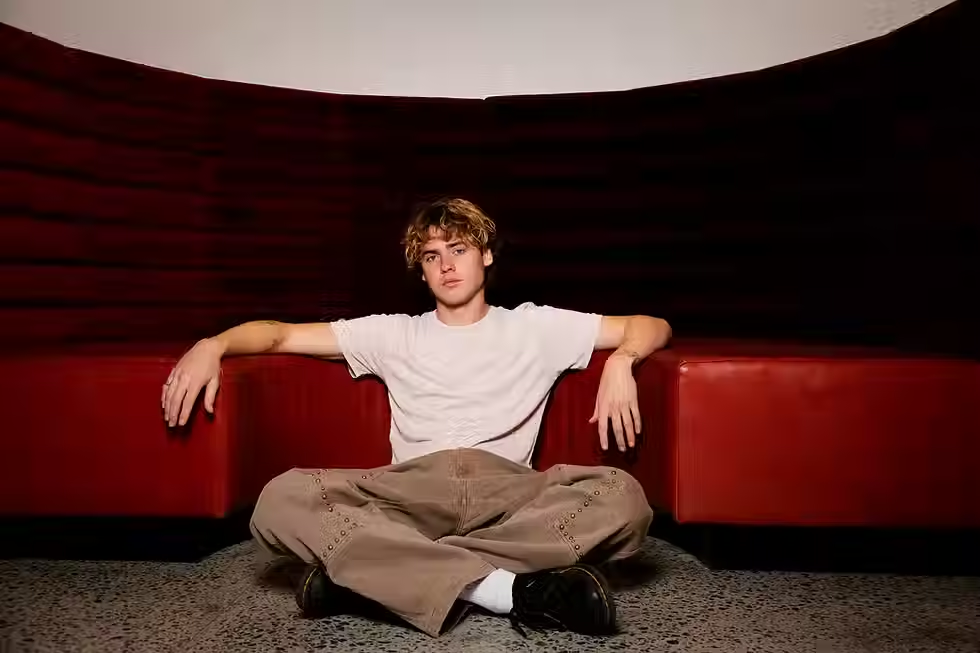
Photographs by Jahnay Tennai
Over the last ten years, BRIT Award-winning rapper Aitch has had one of the most consistent rises in British rap, which has been guided by his sharp lyricism and cultural awareness. His early releases, including Back To Basics and Straight Rhymez gained rapid traction online and within the industry. He quickly positioned himself as a formidable wordsmith - a defining trait that continues to anchor his career. That grounding came into full focus with Close To Home, his critically acclaimed debut album which peaked at number two and earned Aitch a historic BRIT Award win as the first ever Mancunian artist to take out Best Hip-Hop, Grime and Rap Act. Yet the years that followed were defined as much by reflection, as achievement. Between albums, Aitch stepped away from the spotlight to reconnect with family and friends, while deepening his commitment beyond music. That time away also saw Aitch translate advocacy into action, scaling Kilimanjaro as part of his work with the Association for Down Syndrome and surpassing expectations with £160,000 raised - more than double his original £70,000 goal.
Following his 25th birthday, Aitch found himself back in songwriting mode, slowly shaping what would become his second studio album, 4. By the time we meet over Zoom, the record has been in the world for three months - having debuted at #1 on the UK Independent Album chart - long enough for the Manchester rapper to step back from the intensity of release mode and assess the project with a clearer head. That distance has brought a sense of quiet satisfaction. “Do you know what? I'm happy about it. I know I'm happy about it.” he says, before laughing his way into an anecdote that captures that feeling. “Sometimes - this is a weird story - when I get in the shower and I go to put music on, sometimes I get stuck and then I think to myself, 'if I wasn't Aitch now, I would play 4.’ But I feel like a weirdo getting in the shower, I'm playing 4 to myself [laughs].” It’s a small, almost throwaway confession, but it speaks volumes. For an artist who has spent much of his career under the global spotlight, the idea that he can enjoy his own album as a listener - even hypothetically - feels like a personal milestone. The pleasure he finds in 4 isn’t performative or strategic; it’s instinctive, unforced, and rooted in the simple question of whether the music feels good to live with.
That sense of ease runs through Aitch’s thoughts on his own evolution, when I ask him how his artistry has evolved between records. He’s quick to reject the idea that he’s fundamentally changed as an artist, instead framing his growth as a process of adaptation. “I think the best way to put it is I've definitely adapted with the times, but also somehow stayed very - I don't know whether to say unique or just myself, you know what I mean?” Looking back to his earliest breakout moments almost a decade ago, he describes a version of himself driven almost entirely by technical bravado. “If we're talking debut-debut, like back in the day 2017 kind of joints, then I think that back then all I wanted to do was just rap.” He references back then, it was about speed, sharpness and lyrical dominance - rapping faster, harder and better than anyone else in the room.
Now, the focus has softened. The competitive edge is still there, but it’s no longer the driving force. “Now it's more like, can people play through this and just have a good time? I think it’s that simple,” he says, distilling his current mindset down to something refreshingly straightforward. With that shift has come a recalibration of his own ambition. Aitch admits there was a period where he was “really trying to go for them numbers, trying to get radio play every day and trying to get the biggest song in the world.” Conversely, 4 was born in a very different headspace. “I can’t lie, I was just in fairyland having a good time making 4 and put it out and it was just like, ‘yeah, whatever.’” That “fairyland” mentality - half-serious, half-liberated - underpins the album’s spirit. It’s the spirit and glow of an artist loosening his grip on outcomes, and rediscovering the joy of creation for its own sake. “Hopefully everyone else joins fairyland as well and listening to it,” he offers. In that hope lies the essence of 4: not a calculated bid for domination, but an open invitation to share in a moment of freedom and fun.

Aitch has never needed to announce where he’s from; Manchester is an ever present force within his music. The city pulses through 4 in accents, attitude and instinct, less a theme and more of a reflex embedded into his creative DNA. “I think people know by now, if Aitch is doing a project - nine times outta ten he is gonna be screaming Manchester [laughs],” he admits. “That's just a given. No doubt I'm gonna be doing that.” Manchester isn’t a calling card he flashes when necessary; it’s the lens through which his music is made, grounding even his most playful or off-the-cuff moments in a specific cultural weight.
That grounding becomes even more intriguing when placed against 4’s conscious move away from vulnerability. Where his debut invited listeners inward, his latest offering resists introspection in favour of something looser and more instinctive. “For this one, I don't know, I think I kind of based it off Close To Home - my album before that, which I felt was a bit more vulnerable. It had just a little sprinkle more emotion to it than 4 did. So when I was making 4, I kind of wanted to just flip it on its head.” What he describes isn’t a rejection of emotion, but a choice not to linger in it. The album feels less like a confessional and more like a snapshot of movement; a project built on energy, presence and immediacy rather than reflection. “I didn't really have much thought process to it,” he says, underlining how deliberately unburdened the record is. That philosophy carries through to how 4 was constructed. “Do you know what it was? I made CLOCK THE GAME which is track one. I made that first. That was one of the first songs I made on the album and I knew that I wanted that track one straight away.” From that opening number, the rest of the album followed organically rather than conceptually. “It was kind of weird, after that I just kind of made it in order.” Opting away from creating a through-line lyrical narrative, Aitch was guided by sound and momentum when creating the record. “I was thinking about sonically what sounds good next to each other. The verbal storyline or whatever - it wasn't even important to me.” His focus was on how the music would feel in real time, imagining the album as a live experience before it was ever a finished body of work. “I was thinking of it as a set list, as if I'm gonna go on stage now and perform a set list, what would I do? Which has kind of fucked me up really, because when I go and perform now I just wanna do the album in order [laughs]. I feel like people don't want to hear that, you know what I mean? Because they expect it, but it's the perfect set list in my opinion.” There’s humour in the admission, but also conviction. For Aitch, 4 makes sense as a continuous rush of moments, and speaks to a growing confidence in his instincts.
By assuaging himself from the pressure of a concept driven narrative, Aitch allowed each track to exist as its own emotional and social timestamp. “I kind of looked at every track as a bit more of an individual track in terms of what I'm saying. More so than a package sort of thing.” The result is a body of work shaped by whatever he experienced that day. “One day I was making COL4 BODY, I was probably just having fun in the house, dancing around the house with all the mandem, with a speaker on loud, couple drinks and all that.” That energy - communal, loud, celebratory - sits comfortably alongside more intimate moments. “But then the next day, I don't know, I might have had the most sexiest conversation with a female the night before. So then that's on my mind and then I made SOS or something like that.” In turn, he has offered an album that mirrors the uneven rhythm of real life.
When I suggest that the looseness of 4 feels like a truer reflection of how life actually unfolds, Aitch agrees. “That's what I mean. I also didn't wanna create this like fantasy story that didn't really happen. Like we can do that as well. But it's just some real shit really. To be honest, it's just some real shit.” There’s an intentional stripping away of artifice here; a refusal to over-mythologise his own experiences. As I point out that this honesty could perhaps give the album a deeper connection and relatability with fans, he agrees, widening the lens beyond just music. “Yeah man. I also feel like people are a bit scared to be themselves at the minute.” It becomes clear that for Aitch, 4 is as much about permission as it is about sound. “I just wanna show people that you can have fun. You don't need to worry about looking cool as fuck because having fun is cool as fuck basically.” In that sense, the album’s disorder becomes its message: authenticity doesn’t need to glimmer, and joy doesn’t need justification.

At its core, 4 is a melting pot of sound and is Aitch’s most bombastic and sonically adventurous release to date. Built alongside production duos MOJAM and WhyTek, the album stretches well beyond the confines of traditional UK rap, weaving in threads of afro-pop, funk, house, neo-soul and dance, all threaded through the foundation of his established hip-hop realm. It’s a record designed to move and expand the spaces his music can live in without losing its centre. When I ask what drew him towards those genres, Aitch does not highlight a standout moment of pivot, but instead credits his day-to-day music consumption. “It just depends on what I’m listening to,” he says. “At the time when I was making 4, I was just like, I could not get in the shower or get ready without listening to Tyler The Creator or Kendrick Lamar in terms of like a production thing.” He’s quick to clarify that these artists sounds did not directly influence his own sound. “I’m not saying 4 sounds anything like that,” he adds. Instead, it was the feeling those records gave him; the colour, the movement, the sense of intention behind every choice that sparked something.
That influence manifests less in direct sonic parallels and more in philosophy. Listening to artists known for pushing their production into new territory encouraged Aitch to think beyond familiar structures. “It was just giving me them vibes,” he says. “I wanted everything to be a bit more upbeat and sound a bit fun.” But that fun isn’t just a throwaway idea here, it’s about dynamism, energy and refusing to let tracks sit still. In that sense, 4 also reads as a quiet critique of the current UK rap landscape. Aitch doesn’t dismiss the scene, but he does acknowledge a staleness that he felt compelled to push against. “I don't really know in terms of UK rap recently, all the beats have been very monotone, loop, loop, loop, loop, loop all the way through,” he says. “And that's what I didn't want to do.” His response highlights a desire to reintroduce progression and variation into his music. Beats that evolve, switch and surprise, mirroring his own restlessness as an artist. On 4, that refusal to stay in one place becomes part of the album’s identity: a record that moves with intention, curiosity and a renewed sense of play.
Aitch enlists a range of collaborators on the album, including Chimpo, Pozer, AJ Tracey, and Anne-Marie, each of whom brings a distinct energy that complements his own songwriting flow. For Aitch, collaboration has always been less about strategy and more about natural chemistry and finding voices that sit effortlessly alongside his own. When I ask him how he chooses his collaborators, he breaks down the albums features and starts by recalling the making of BUSINESS with Avelino. “We linked up and went to the studio together and just made that on some random shit,” he says. The song came together in about forty minutes, though the rest of the day was spent talking about their shared love for football. “There’s actually footage of that somewhere, six-hour footage of us just in the studio talking about football.” For Aitch, the spontaneity of the session made the collaboration effortless. “That was just a no-brainer. There was no thought process to that whatsoever,” he adds. The story underscores how, for him, the strongest collaborations often come organically, from shared energy, mutual respect, and simple camaraderie, rather than from meticulous planning.
Other tracks, however, are more deliberate in their pairing. Take CLOCK THE GAME featuring Chimpo. “In my head when I was making it, I was just like, ‘I need Chimpo on this. It is the only person I can hear on it,’” Aitch explains. Similarly, for TEST with AJ Tracey, the collaboration sprang directly from the beat itself. “As soon as I heard that beat, I’m like, ‘yeah, this is me and AJ,’” he says. These examples reveal a different approach: sometimes the music dictates the partnership, with the artist’s imagination filling in who could bring the right voice, tone, or energy to a track. Then there are moments of pure chance, as with LUV?. “That was already Anne-Marie’s song. She done that. That was already a three-minute song, all Anne-Marie, and one day when she didn’t know, I just went in the studio and put my shit on it and then sent it to her and said, ‘hope you like it’ [laughs],” he recalls. “I had my fingers just crossed and she liked it, so I took it. It was just all random.” Across the album, whether through careful selection or happy accidents, collaboration emerges as a reflection of Aitch’s personality: intuitive, playful, and guided by musical chemistry above all else.

Aitch was set to visit Australia this month, to perform a string of headline shows as well as festival appearances. Weeks out from the tour's commencement, the rapper cancelled the tour due to unforeseen circumstances. When we spoke, he showed genuine excitement for his return to Australia. “Knowing what all you lot are like, you lot are gonna go crazy anyway,” he declared. “I've been over there so many times as well at this point, I'm not just saying this on some promo, I wouldn't say this if I was going anywhere else, but I just feel like it is kind of like a bit of a second home now. So like when I go over there, I just feel mad comfortable. I feel like you like get it. That's all I can say. I feel like you just get it. So like when I'm on stage, it's nice.”
Whilst Australia won’t get the chance to experience 4 live at present, the weight and gravity of being able to perform for fans is not lost on Aitch. He notes his own experiences as a music lover, how that influences the presence of performing live with his adoring fans. “I've been fans of artists back in the day when I was a kid who still to this day, I've never got to see them perform, and it's sickening. So I can't let that happen. I can't. I hope there's not many people in the world that go out without seeing me perform.” Aitch’s astute observations on the exchange between artist and audience, and how that relationship blossoms within the live sphere is genuine and heartwarming. He would like each individual who listens to his music to feel his appreciation, and know how they have changed his life. It also offers a chance for him to understand the magnitude of his art and his career, and the impact it has had on other people's lives. “It's also important for me to understand, I suppose what I've done. If I'd never done a tour in Australia, I'd just be sat in England all the time, never knowing that all these people are screaming my name over there. You know what I mean? So it's good. It makes you realise certain things and makes you realise that what you're doing is, 'oh, you're doing it well.’”
Since the release of 4 in June, Aitch has played a handful of shows - most notably in his beloved Manchester in October. The Australian tour was set to be his first full-length stretch playing the new tracks live, and he shared with me his setlist is constantly morphing depending on where he is playing. “This is a good way to put it. If I'm somewhere in a place that their first language isn't English, then I will just go for really my biggest songs. Because I feel like they would more than likely know them ones. Whereas say I'm in Manchester, it's hard because people wanna hear the super old school shit. But I'm trying to do the new shit.” With a number of hits under his belt, and a bevy of fan favourites to choose across his discography, he was viewing his live show as a greatest hits performance. “Look at it like Aitch's greatest hits, like I'm dead [laughs]. It'll just be a big mashup of everything. Like people will get enough of 4, enough of Close To Home, enough of all the singles around all these things, features and whatnot. I'll make sure I do alright.” Whilst no 2026 tour dates have been announced, Aitch’s return to the stage is sure to be an electric moment that unites him with his fans.
There is one other thing Aitch is looking forward to upon his return to our shores; seeing a kangaroo for the first time. “Listen, I will go mad in a minute, right? Because I've been to Australia, what, four times, maybe five. Never once in my life have I seen a kangaroo,” he tells me. “That has to change. But at this point I believe that they're not real.” I tell him it’s rare to see a kangaroo when visiting main cities, and he’s more likely to see them when visiting rural and inland Australia. He also notes he has yet to see a spider during his Australian travels. I tell him in my twenty eight years, I’ve only been bitten by a spider once. “Tour's cancelled [laughs],” he joked.
MILKY EXCLUSIVE COVER STORY ©
Writer: Vasili Papathanasopoulos
Photographer: Jahnay Tennai


Comments