HIGHSCHOOL 'HIGHSCHOOL' REVIEW
Watch our interview with HighSchool below!
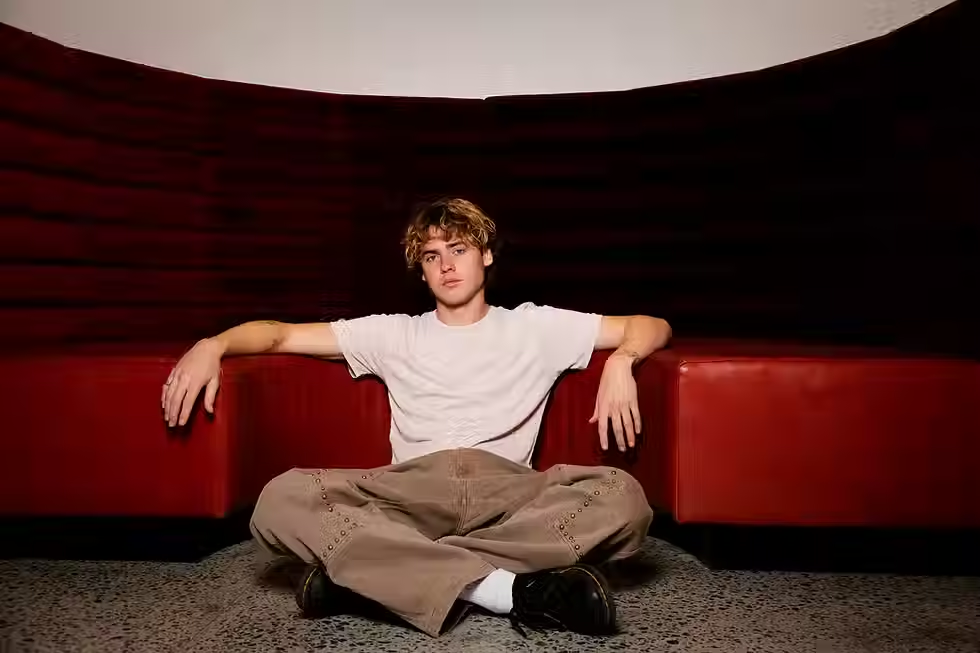
HighSchool’s self-titled debut arrives already carrying a quiet mythology. After years of EPs that hinted at something larger, and a steady ascent through London’s Windmill ecosystem and international touring, Rory Trobbiani and Luke Scott finally commit their vision to a full-length statement. Rather than opting for reinvention, the duo refine what has always defined them: youth as a state of heightened emotion, suburbia as a site of understated drama, and guitars that shimmer, churn, and collapse in on themselves.
That focus is reflected in the album’s sound. Produced by Ben Hillier and Finn Bellingham, HighSchool feels deliberate without ever tipping into over-polish. Its palette draws from 80s post-punk austerity and contemporary alternative revivalism, but never settles into pastiche. Brittle drum machines sit alongside hazy guitar washes; melancholic melodies are interrupted by sudden surges of euphoria. Across twelve tracks, the sequencing feels intentional, mirroring a slow emotional and artistic unfolding rather than chasing immediate peaks.
That immersion is driven in large part by the albums lyricism and vocal delivery. Trobbiani’s writing is visceral and sharply observed, favouring concrete images and emotional specificity over abstraction. Small details - objects, rooms, gestures - are rendered with a vividness that makes each song feel lived-in rather than narrated. Vocally, there’s an understated magnetism at play: lines are delivered in a way that feels intimate but never confessional, luring the listener in rather than demanding attention. Across the record, the vocals function as a guiding thread, holding focus and momentum even as the arrangements shift and expand. Everything here feels designed to capture and sustain attention, pulling the listener deeper into the sonic and thematic world HighSchool are building.
What gives HighSchool its emotional centre is the duos own framing of the album as an attempt to reconnect with intensity and the sense that everything once felt sacred. That idea runs through every song. Rather than simply describing youth, HighSchool recreates its exaggerated stakes. Early tracks like 149 and Dipped pulse with nervous momentum, capturing the thrill and confusion of first freedoms. Sony Ericsson refracts romance through a digital lens, where intimacy and distance collapse into the same glowing screen.
As the album progresses, that restless energy gives way to reflection. Tracks like American Aunty and Peter’s Room retreat into domestic spaces, finding emotional weight in bedrooms, family ties, and half-remembered conversations. While these songs lean more heavily into alternative rock textures, they remain unmistakably HighSchool: restrained, elliptical, and emotionally precise. Nothing is overstated; feeling arrives in fragments, glances, and unresolved thoughts.
The second half broadens the emotional and sonic scope without sacrificing cohesion. One Lucky Man channels early-2000s indie swagger, grappling with the tension between self-control and indulgence, and lingering on the quiet aftermath rather than the thrill itself. From there, the album drifts through a series of increasingly textured memories: the wistful ache of Making Out at the Skatepark, the distorted analog haze of Trope, and the shadowy, expansive atmosphere of Rhinoplasty. These songs feel less like snapshots than recollections - revisited, reshaped, and softened by time.
By the time HighSchool reaches its closing stretch, from the local specificity of Best and Fairest to the Italo-disco shimmer of Colt, HighSchool feels less like a collection of songs than a carefully assembled document. Not a diary, but an archive of sensations: boredom, desire, misdirection, longing. The album doesn’t romanticise youth so much as acknowledge its intensity and impermanence.
In leaning into the myth-making power of 'school' as a cultural symbol (shaped as much by film and television as lived experience), HighSchool contributes its own version of that story. It’s an album about trying to remember how it felt when emotions arrived without filters, when meaning was over-assigned to the smallest moments. Twelve songs later, Trobbiani and Scott don’t pretend to have reclaimed that feeling entirely; but they come close enough to make it hurt, in the best possible way.
HighSchool is out now.


Comments